



Top EU official responds to US over Lutnick warning:
A top European Union official on Wednesday accused the Trump administration of using “blackmail” to force the 27-nation bloc to weaken regulations affecting American technology companies.
Commerce Secretary Howard Lutnick, who visited Brussels for trade talks earlier this week, called on the EU to roll back its digital rules in exchange for a reduction in US tariffs on steel and aluminum.
“They would like to have steel and aluminum as part of this package,” Lutnick told Bloomberg TV on Monday. “And we think it’s very, very important that they understand our digital businesses and reconsider their digital regulations to make them more attractive to our large businesses.”
“Take your foot off the regulatory filing, build those data centers in the United States, and in exchange for that, we’ll get a cool deal on steel and aluminum,” Lutnick added.
Lutnick also urged the EU to resolve its cases against Google and Amazon, while noting that the bloc would attract up to $1 trillion in investment if it followed his advice to weaken its digital rules.
“I’m trying to convince them that winning like Donald Trump is winning in the United States is the way to go,” Lutnick told Bloomberg.
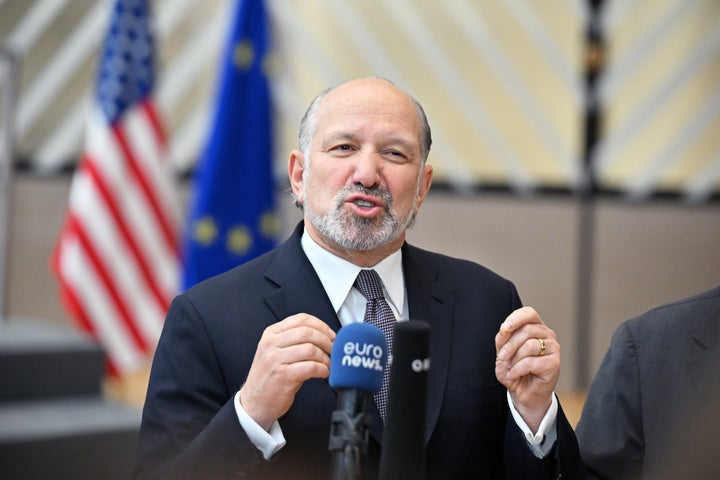
Dursun Aydemir/Anadolu via Getty Images
However, Teresa Ribera, the bloc’s antitrust chief, told Politico that the United States should not dictate the European Union’s digital regulation.
“It’s blackmail,” Ribera told the outlet. This “being their intention does not mean that we accept that type of blackmail.”
The EU and the United States reached a trade deal over the summer, establishing a 15% tariff on most products, but the agreement does not cover steel, aluminum and other derivative products that contain them. The United States still has a 50% tariff on metals.
Lutnick’s criticism appeared to be directed at the bloc’s Digital Markets Act, which aims to limit the power of big tech companies, and its Digital Services Act, which controls online content.
Last week, the EU unveiled new proposals that would delay the implementation of stricter rules on the use of AI in “high-risk areas” such as biometric identification and also relax privacy regulations, prompting criticism from 127 civil groups that called the measure “the biggest rollback of digital fundamental rights in EU history,” according to Reuters.
“It is disappointing to see EU“The European Commission is giving in under pressure from the Trump administration and the big tech lobbies,” said a Dutch member of the European Parliament, Kim van Sparrentak, according to the news agency.