



Trump calls Colombian president an illegal drug leader
PALM BEACH, Fla. (AP) — The United States will cut aid to Colombia because its leader, Gustavo Petro, “does nothing to stop” drug production, President Donald Trump said Sunday, intensifying friction between Washington and one of its closest allies in Latin America.
In a social media post, Trump referred to Petro as “an illegal drug kingpin” who has “low qualifications and is very unpopular.” The Republican president warned that Petro “better shut down” the drug trafficking operations “or the United States will shut them down for him, and it won’t be done right.”
Hours later, Defense Secretary Pete Hegseth announced the latest U.S. attack on a ship allegedly carrying “substantial quantities of narcotics.”
He said the ship was associated with a Colombian rebel group, the National Liberation Army or ELN, which has been in conflict with Petro’s government. He did not provide any evidence for his claims, but shared a short video clip of a ship engulfed in flames after an explosion on Friday.
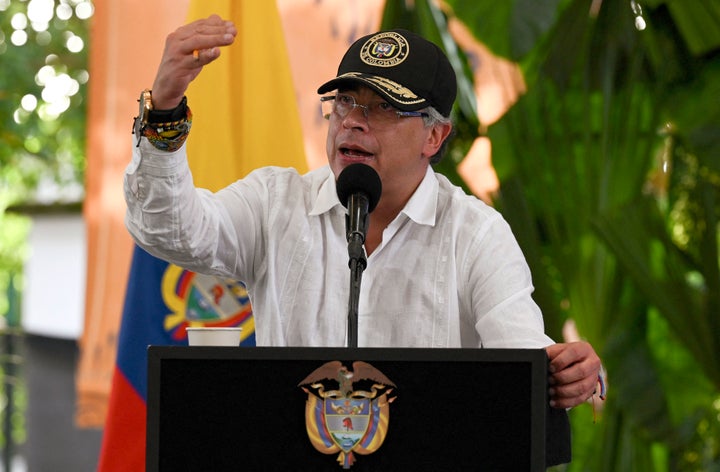
David Salazar/News via Getty Images
Petro, who can be as vocal on social media as his American counterpart, rejected Trump’s accusations and defended his work fighting narcotics in Colombia, the world’s largest cocaine exporter.
“Trying to promote peace in Colombia is not being a drug trafficker,” Petro wrote. He suggested Trump was being misled by his advisers, described himself as “the main enemy” of drugs in his country and said Trump was being “rude and ignorant to Colombia.”
The Colombian Foreign Ministry described Trump’s statement as a “direct threat to national sovereignty by proposing an illegal intervention in Colombian territory.” Defense Minister Pedro Sánchez told reporters that the country “has used all its capabilities and has also lost men and women fighting drug trafficking.”
Trump’s latest broadside against Petro raises the possibility of an escalating confrontation in Latin America, where the United States has already increased pressure on neighboring Venezuela and its leader, Nicolás Maduro.
American warships, fighter jets and drones are deployed in the region for what the government has described as an “armed conflict” with drug cartels. Trump also authorized covert operations inside Venezuela.
Unlike Venezuela, Colombia is a long-time ally of the United States and the main recipient of American assistance in the region. But coca cultivation hit an all-time high last year, according to the United Nations, and there has been fresh violence in rural areas where the government spent years fighting insurgents before reaching a peace deal a decade ago.
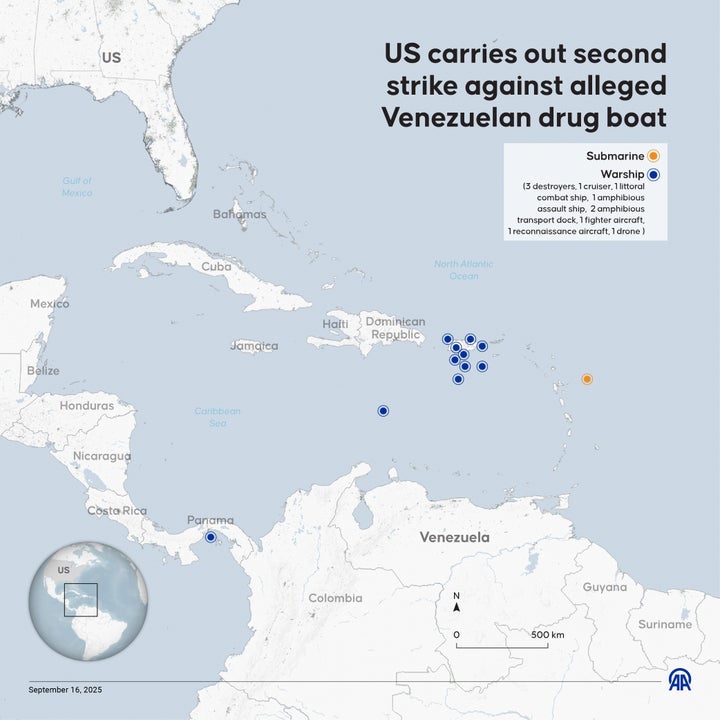
Elif Acar/Anadolu via Getty Images
In September, the Trump administration accused Colombia of not cooperating in the drug war, although at the time Washington issued a waiver of sanctions that would have led to aid cuts.
Colombia received approximately $230 million in the U.S. budget year that ended Sept. 30, a drop from recent years that exceeded $700 million, according to U.S. figures.
Petro, Colombia’s first leftist president, has repeatedly feuded with Trump this year. Petro initially rejected US military flights of deported immigrants, prompting Trump to threaten tariffs. The State Department said it would revoke Petro’s visa when he attended the U.N. General Assembly in New York because he told U.S. soldiers to disobey Trump’s orders.
Petro and Trump have also been at odds over US attacks on ships in the Caribbean. On Sunday, Petro accused the U.S. government of murder, pointing to a Sept. 16 attack that he said killed a Colombian named Alejandro Carranza. Petro said Carranza was a fisherman with no ties to drug trafficking and that his boat was not working properly when it was hit.
“The United States has invaded our national territory, fired a missile to kill a humble fisherman, and destroyed his family, his children. This is Bolívar’s homeland, and his children are being murdered with bombs,” Petro wrote on social networks. He said he asked his country’s attorney general to initiate legal proceedings internationally and in US courts.
The White House and Pentagon did not immediately respond to requests for comment on Petro’s allegations.
Despite Petro’s criticism, his government plans to prosecute the Colombian survivor of a more recent US attack on a submersible allegedly transporting drugs.
Another survivor was repatriated to Ecuador, where the Interior Ministry said he would not face charges after prosecutors met with him and determined he had not committed any crimes within the country’s borders.
The ELN, which Hegseth said was the target of Friday’s attack, has long denied any involvement in drug trafficking and offered to submit to scrutiny by an international commission. He did not respond to Hegseth’s announcement. Colombian authorities regularly report the dismantling of cocaine laboratories and the seizure of drugs believed to belong to the guerrillas.
There have been seven US attacks in the region since early September that the administration says target suspected drug traffickers. At least 32 people have died.
Trump said Sunday that Petro had “a fresh mouth toward the United States.” He complained that drug smuggling continues “despite large-scale payments and subsidies from the United States, which are nothing more than a long-term scam by the United States.”
“STARTING TODAY THESE PAYMENTS, OR ANY OTHER FORM OF PAYMENT, OR SUBSIDIES, WILL NO LONGER BE MADE TO COLOMBIA,” he added.
Elizabeth Dickinson, senior analyst for the Andes region at International Crisis Group, said that “it is disconcerting and deeply reckless for the United States to distance itself from its strongest military partner in Latin America at a time when tension between Washington and Venezuela is at its highest point in recent years.”
He said Washington and Bogotá have long considered their relationship fundamental, but “that wisdom is being thrown out the window, with truly catastrophic effects.”
Colombia lost significant US funding when Trump slashed the US Agency for International Development earlier this year. Further cuts could affect military cooperation and undermine efforts to fight rebel groups.
“If that is cut, we will see a strategic loss of capacity for the Colombian army and police precisely at the moment when they face the biggest security crisis in Colombia in more than a decade,” he said.
___
Coto reported from San Juan, Puerto Rico, and Suárez from Bogotá, Colombia.
___
This story has been corrected to reflect that Trump called Petro “an illegal drug kingpin,” not “an illegal drug dealer.”