



Trump is making a closing deal nearly impossible
Democrats have successfully framed what is now the second-longest government shutdown in American history around the issue of health care. Some three weeks later, the party remains on solid ground and appears unlikely to concede.
Especially when you consider another major reason why this will likely become the longest government shutdown in history, dragging on with no end in sight: President Donald Trump has usurped Congress’s power to appropriate and direct government spending and refuses to give it back. In doing so, Trump has broken any semblance of confidence Democrats may have that their side of any deal they reach will be fulfilled after a bill is passed.
Since taking office, Trump has unilaterally seized funds appropriated by Congress, frozen funding for scientific research, canceled infrastructure grants largely in Democratic-run states, laid off tens of thousands of government workers, shuttered entire agencies and attempted to shutter others. And it has escalated these practices, which range from provocative to downright illegal, during the lockdown.
Most disturbingly, Trump redirected Defense Department funds intended for research and development to pay salaries for troops who would otherwise go unpaid during the shutdown. This money was appropriated by Congress for one purpose and is now, by Trump’s unilateral order, being used for another. That is neither legal nor constitutional. The White House did not immediately respond to a request for comment.
“President Trump has committed the broadest set of illegal budget actions of any president in American history,” said Bobby Kogan, a former official in President Joe Biden’s Office of Management and Budget and now senior director of federal budget policy at the Center for American Progress, a liberal nonprofit. “This is his most illegal budget action, by far, by a parsec.”
These actions, many of which are illegal and unconstitutionally usurp the financial power of Congress, show why it is nearly impossible for Democrats to reach a deal. What’s the point of making a deal when Trump refuses to spend the money Democrats want to spend or decides to spend that money on something else entirely? The normal government funding process involves making deals in which members and parties haggle to get funding for their priorities. If that fails, then what is Congress for?
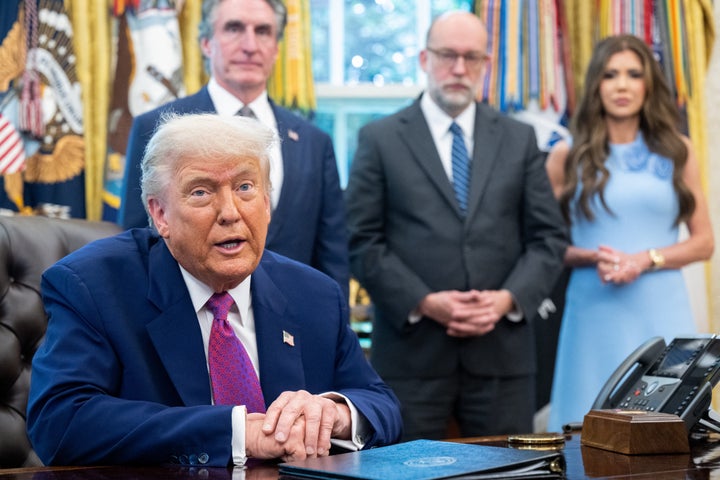
SAÚL LOEB via Getty Images
Congress is the only body empowered by the Constitution to appropriate money to be spent by the government. The president cannot spend money that has not been appropriated by Congress, nor refuse to spend money that Congress has appropriated, except in very limited circumstances. The Constitution’s grant of this power to Congress is supported by laws including the Embargoment Control Act, which limits how the president can refuse to spend money, the Antideficiency Act, which prohibits the executive branch from spending money that has not been appropriated by Congress, and the Purpose Statute, which limits agencies to spending money only on “objects for which appropriations were made.”
“You’re now breaking both ends of spending by not spending money you don’t feel like spending and spending money you don’t have to spend,” Kogan said. “It sort of makes all assignments optional. How is an agreement supposed to be reached in that context?”
Sen. Rubén Gallego (D-Ariz.) put it more directly. “We have a trust issue,” he previously told News themezone.
The usurpation of Congress’s purchasing power by taking money from one account to spend in another is just the latest part of its egregious push for unitary power.
During his first term, Trump was impeached after withholding funds from Ukraine, a violation of the Seizure Control Act, seeking information on his 2020 rival, Joe Biden. When he ran for re-election in 2024, he campaigned on a promise to challenge the constitutionality of the Foreclosure Control Act in court. Within days of taking office, Trump’s OMB seized billions of dollars in funds. The Trump administration has already committed seven violations of the law, according to decisions by the Government Accountability Office. While the total amount of funds seized will not be known until later in 2025, the GAO is currently investigating no fewer than 46 seizure cases by the Trump administration.
WBO Director Russ Vought, whom Trump refers to as the “Reaper” and “Darth Vader,” is the mastermind and face of Trump’s money power grab. Vought has vowed to use all available tools to restrict spending and shrink government, including those that are illegal or unconstitutional, as he believes it is necessary to “get rid of legal precedents and paradigms that have been wrongly developed over the last 200 years,” to stop the country’s descent into “a complete Marxist takeover of the country.”
Trump and Vought have since claimed that they used the shutdown to cause pain to their political enemies. They canceled billions in grants to Democratic-leaning states and fired thousands of “Democratic agencies.” They have engaged in mass layoffs, although their court filings belie their claims that this is related to the closure. And they have cast doubt on the future reliability of any deal Democrats might reach to fund the government by saying they would cut funding as they see fit through rescission legislation. Speaker Mike Johnson (R-La.) didn’t help matters either when he said Oct. 10 that “a termination package is part of our process.”
The decision to use an R&D budget to pay for troops further compounds this problem: it demonstrates that the administration is willing to go even further in its lawbreaking than its efforts to challenge the Embargoment Control Act.
“Now they seem willing to set aside the Antideficiency Act,” said Cerin Lindgrensavage, a lawyer with Protect Democracy, a pro-democracy nonprofit. “To the extent that they were already crossing the line, that’s another line that I don’t think I expected them to cross so blatantly.”
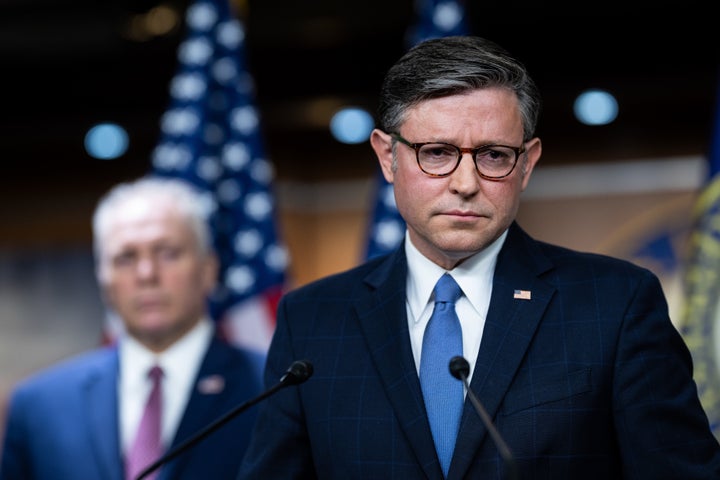
Graeme Sloan/Bloomberg via Getty Images
The problem that Trump and Vought have created goes beyond the negotiation. The appropriations process is not only a means of financing the government, but it is also an important constitutional mechanism for one branch to check another. If Congress does not approve of a president’s policies or how he runs the government, it can change how it funds the government or impose additional limitations or conditions on what the president can do with the money Congress appropriates. But when the president unilaterally refuses to spend money appropriated by Congress or spends money not appropriated by Congress, as Trump is doing, the entire purpose of Congress and the constitutional design of the entire government is undermined.
Even some Republicans recognize the problems Trump is creating for Congress by usurping budget power.
“If you’re a Democrat, even a mainstream Democrat, your bias might be to help negotiate with Republicans on a funding mechanism,” said Rep. Steve Womack, R-Ark. on the Appropriations Committee. he told politician. “Why would you do that when you know that whatever you negotiate will be subject to the knife that Russ Vought pulls on you?”
“[Democrats’] The concern right now, and it’s a legitimate concern, is: How can we reach a deal when our OMB director is just going to confiscate the funds and say we’re not going to spend them there? Rep. Mike Simpson, a Republican appropriator from Idaho, told the Bloomberg government.
“If you’re a Democrat, you look at it and say, ‘Why am I going to try to be helpful, if Mr. Vought and OMB are just going to make a covert move and rescind what we’ve been working on?’” Sen. Lisa Murkowski (R-Alaska) told reporters on October 14.
Once upon a time, Congress maintained a sense of institutional identity by which its members, regardless of party, protected their constitutional powers from the intrusion of the president. At times, Congress chose to cede power or create new power-sharing agreements with the president, but this was done to maintain Congress’s power amid changing circumstances. All of that appears to be fading as the Republican Party embraces a strongman theory of the presidency.
Congressional Democrats did put some restrictions on Trump’s abuse of earmarks in his continuing resolve to fund the government. These include limiting the expedited process for termination legislation, ending out-of-pocket terminations, and expanding the availability of funds frozen by Trump’s OMB. Now, this has no chance of becoming law, as Republicans are on the same level as Trump, who would also veto such legislation.
The question is when, if ever, Congress regains a sense of self-esteem and defends its turf as it has in past confrontations with the executive.
Forget the dance hallsHelp build anewsroom
Your supportFuelsOur Mission
Your supportFuelsOur Mission
Become a News themezone Member
When power accumulates under gilded ceilings, true journalism remains outside, asking the questions that matter. Join the News themezone membership and keep independent reporting strong for everyone.
We remain committed to bringing you the unwavering, fact-based journalism everyone deserves.
Thank you again for your support along the way. We are truly grateful for readers like you! Your early support helped get us here and strengthened our newsroom, keeping us strong in uncertain times. As we continue, we need your help more than ever. We hope you will join us once again.
We remain committed to bringing you the unwavering, fact-based journalism everyone deserves.
Thank you again for your support along the way. We are truly grateful for readers like you! Your early support helped get us here and strengthened our newsroom, keeping us strong in uncertain times. As we continue, we need your help more than ever. We hope you will join us once again.
News themezone Support
Are you already a member? Sign in to hide these messages.
“What will it take for Congress to get to the point where it is institutionally prepared to explore ways to hold the administration accountable for not following the laws?” Lindgrensavage said. “And that’s still what we haven’t seen yet.”