



Trump’s decision to attack Iran creates global chaos just days later
WASHINGTON – When Donald Trump released a short video early Saturday about the war that had just begun with Iran, he neglected to mention the predictable consequences.
Like a stock market in free fall. Or increase oil prices around the world and gasoline prices at home. Or tens of thousands of American citizens stranded in the Middle East. Or Iran attacking its neighbors and provoking a regional war with metastases.
Less than four days later, all of this has happened, which will likely make Trump’s massive attack on Iran at the behest of Israeli leader Benjamin Netanyahu even less popular among Americans than it already is.
“It’s not clear to me what Trump’s primary goal is, or how long it will last before something else takes its place,” said John Bolton, one of Trump’s national security advisers in his first term and a decades-long advocate of taking a hard line against Iran. “There are compelling arguments for regime change in Iran, but he hasn’t achieved it yet.”
The Dow Jones Industrial Average closed Tuesday 1,000 points lower than Friday afternoon, hours before Trump’s attack began. Oil prices are up 13% since Friday and gas prices rose 11 cents overnight and now average $3.11 nationally.
In his first question-and-answer session with the press since the war began – aside from brief telephone interviews with select journalists – Trump defended his decision to attack Iran and downplayed the chaos it has already created. He even contradicted his own Secretary of State Marco Rubio’s explanation that the United States had to act because Israel was about to attack Iran on its own, which would have dragged the United States into the conflict anyway.
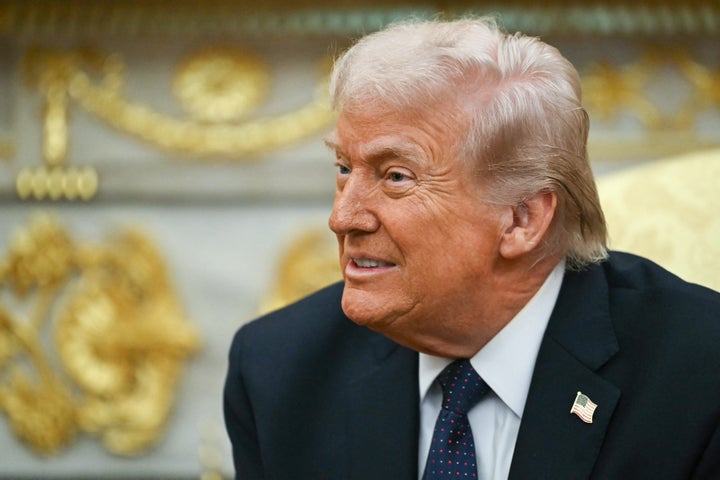
ANDREW CABALLERO-REYNOLDS via Getty Images
Trump said he decided that Iran, not Israel, was about to strike first, a claim his own intelligence community contradicts.
“It was my opinion that they were going to attack first. They were going to attack if we didn’t, they were going to attack first. I firmly believed that,” Trump said at a photo opportunity in the Oval Office with visiting German Chancellor Friedrich Merz.
Trump, who had been planning the attack on Iran for months and had deployed two full aircraft carrier strike groups to the area, claimed his decision had come too quickly to allow for the timely evacuation of American citizens from the region.
“Because it all happened so quickly. We thought, and I thought maybe more than most, that I could ask Marco, but I thought we were going to have a situation where we were going to be attacked. They were preparing to attack Israel, they were preparing to attack others, you’re seeing that right now,” he said, before going on an 800-word tangent about high-end munitions and the Russian invasion of Ukraine and how that would never have happened if he had been president and some insults from his predecessor, Joe Biden.
When asked about oil price increases, Trump said they would go away when the war ended. “So, yes we have oil prices a little bit high for a while, but as soon as this is over, those prices are going to drop, I think, even more than before,” he said.
Trump’s claim that it all happened so quickly will likely provide little comfort to Americans, both expatriates and visitors, stuck in the region. While the State Department urged U.S. citizens on a list of 14 Palestinian countries and territories to leave immediately, the U.S. Embassy in Israel told Americans hoping to do just that, that because the main airport was closed, they should take a bus to Egypt and try to find a flight from there. “If you choose to take advantage of this option to depart, the United States government cannot guarantee your safety,” the notice states.
Trump later announced in a social media post that the U.S. government would assume the risk of financial responsibility for all shipments, regardless of nationality, in the Persian Gulf, including the Strait of Hormuz, the choke point in the far southeast that Iran is trying to close.
“Effective IMMEDIATELY, I have directed the US Development Finance Corporation (DFC) to provide, at a very reasonable price, political risk insurance and financial security guarantees for ALL maritime commerce, especially energy, traveling through the Gulf. This will be available to all shipping lines. If necessary, the US Navy will begin escorting tankers through the Strait of Hormuz, as soon as possible,” Trump wrote. “No matter what happens, the United States will guarantee the FREE FLOW of ENERGY to the WORLD. THE ECONOMIC and MILITARY POWER of the United States is the GREATEST ON EARTH. More actions to come. Thank you for your attention to this matter!”
In his meeting with Merz, Trump also acknowledged the lack of a plan for when Iran’s Islamic regime loses control of the country. In earlier days he told reporters that his “model” had been his assault on Venezuela in early January, when U.S. special forces troops were able to find and kidnap that country’s dictator, and his second-in-command took power after agreeing to Trump’s demands for a cut in Venezuela’s oil revenue.
That model, Trump agreed, seemed implausible in Iran, where the bombing campaign has killed low-level leaders Trump hoped to install to govern the country.
“Most of the people we had in mind are dead. So, you know, we had some of that group in mind who are dead, and now we have another group. They may also be dead according to reports. So, I guess a third wave is coming and pretty soon we won’t know anyone,” he said.
While Trump told the New York Post on Monday that he was not ruling out deploying US troops to Iran, he was also trying to persuade Kurdish armed groups in Iraq to take control of Iran, effectively serving as their proxy army, according to another report.
When asked about that possibility, White House press secretary Karoline Leavitt responded: “President Trump has been in contact with many allies and partners in the region over the past few days.”
However, in American diplomatic parlance, “allies” and “partners” have specific definitions, none of which appear to apply to Kurdish groups in Iraq or Iran, so it is unclear what Leavitt meant.
Related