



Trump’s orders
WASHINGTON (AP) — President Donald Trump said Tuesday he will order a blockade of all “authorized oil tankers” entering Venezuela, increasing pressure on the country’s authoritarian leader, Nicolás Maduro, in a move that appeared designed to impose tighter control on the South American country’s economy.
Trump’s escalation comes after US forces last week seized an oil tanker off the coast of Venezuela, an unusual move that followed a buildup of military forces in the region. In a social media post Tuesday night announcing the blockade, Trump alleged that Venezuela was using oil to finance drug trafficking and other crimes and vowed to continue military buildup until the country gave the United States oil, land and assets, although it was unclear why he felt the United States had a right.
“Venezuela is completely surrounded by the largest Navy ever assembled in the History of South America,” Trump said in a post on his social media platform. “It will only get bigger, and the impact on them will be like they have never seen before, until such time as they return to the United States of America all the oil, land and other assets they previously stole from us.”
Pentagon officials referred all questions about the position to the White House.
The buildup has been accompanied by a series of military attacks against vessels in international waters in the Caribbean and eastern Pacific. The campaign, which has drawn bipartisan scrutiny among U.S. lawmakers, has killed at least 95 people in 25 known attacks on boats.
The Trump administration has defended it as a success, saying it has stopped drugs from reaching American shores, and rejected concerns that it is pushing the boundaries of legal warfare.
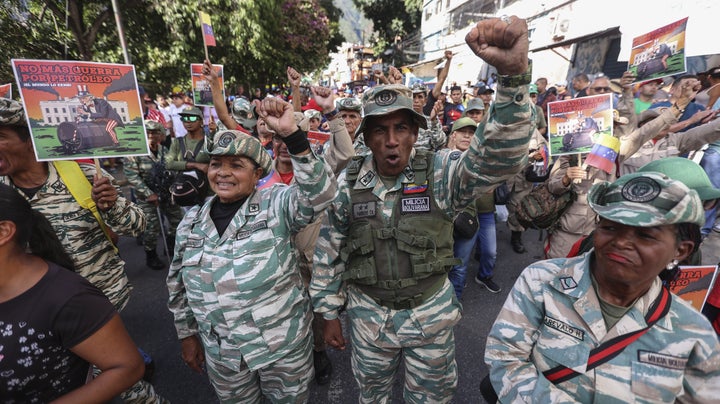
Photo by Pedro Rances Mattey/anadolu via Getty Images
The Trump administration has said the campaign is aimed at stopping drugs headed to the United States, but Trump’s chief of staff, Susie Wiles, appeared to confirm in an interview with Vanity Fair published Tuesday that the campaign is part of an effort to overthrow Maduro.
Wiles said Trump “wants to keep blowing up ships until Maduro cries uncle.”
Tuesday night’s announcement appeared to have a similar goal.
Venezuela, which has the world’s largest proven oil reserves and produces about 1 million barrels a day, has long relied on oil revenues as a lifeblood of its economy.
Since the Trump administration began imposing oil sanctions on Venezuela in 2017, Maduro’s government has relied on an obscure fleet of unflagged oil tankers to smuggle crude into global supply chains.
State oil company Petróleos de Venezuela SA, commonly known as PDVSA, has been excluded from global oil markets by US sanctions. It sells most of its exports at deep discounts on China’s black market.
Francisco Monaldi, an expert on Venezuelan oil at Rice University in Houston, said about 850,000 barrels of the million daily production are exported. Of that, he said, 80% goes to China, between 15% and 17% goes to the United States through Chevron Corp. and the rest goes to Cuba.
It was not immediately clear how the United States planned to enact what Trump called a “TOTAL AND COMPLETE BLOCKADE OF ALL SANCTIONED OIL TANKERS entering and leaving Venezuela.”
But the US Navy has 11 ships, including an aircraft carrier and several amphibious assault ships, in the region.
Those ships carry an extensive complement of aircraft, including helicopters and V-22 Ospreys. Additionally, the Navy has been operating a handful of P-8 Poseidon maritime patrol aircraft in the region.
In total, those assets provide the military with a significant ability to monitor maritime traffic entering and leaving the country.
___
News writers Konstantin Toropin in Washington and Regina García Cano in Caracas, Venezuela, contributed to this report.