



Trump’s summary murders of dozens aboard ships appear to be based on a massive lie about fentanyl
WASHINGTON — President Donald Trump’s justification for summarily killing suspected drug traffickers, rather than arresting, trying and convicting them in court, appears to be based on a massive lie: that they were in the process of bringing the deadly synthetic opioid fentanyl into the United States.
“You can see, ships are hit and you see fentanyl all over the ocean,” Trump said at a news conference on Oct. 15, the day after the fifth of what are now 15 deadly attacks on ships in the Caribbean Sea and eastern Pacific Ocean that have killed 65 people. “It’s, like, floating in bags. It’s everywhere.”
“Every ship we shoot down we save 25,000 American lives,” Trump also told reporters.
“US intelligence confirmed that this ship was loaded primarily with fentanyl and other illegal narcotics,” he wrote in a social media post three days later about another missile attack on October 16.
However, the claim that missile attacks on small vessels (in most cases too small to have been en route to the United States without requiring multiple refueling stops) are disrupting fentanyl trafficking into the United States is belied by what Pentagon officials have told members of Congress in recent briefings.
“They have not recovered fentanyl in any of these cases. It has all been cocaine,” said a congressional source familiar with the contents of one of the reports.
“They argued that cocaine is a drug that facilitates fentanyl, but that was not a satisfactory answer for most of us,” California Democratic Rep. Sara Jacobs told reporters after a briefing she attended last week for members of the House Armed Services Committee.
The growing frustration over the lack of clear information is bipartisan. Last week, the Senate Armed Services Committee, chaired by Mississippi Republican Roger Wicker, took the unusual step of posting on its website two letters demanding details about how the military is carrying out the boat strikes.
“I get no tracking. We get no information. How do they choose this ship?” added Oklahoma Republican James Lankford, a member of the Senate Intelligence Committee.
Pentagon officials have also told lawmakers that they don’t actually know the identities of all the people they have killed in these attacks, only that each ship had at least one person on board who is on a target list of drug cartel members that the administration has created, the congressional source said.
“They didn’t know the names of all the people who were on these boats,” the source said. “In some cases, they only know one person.”
This contrasts with statements from Secretary of Defense Pete Hegseth and Secretary of State and national security advisor Marco Rubio suggesting that military and intelligence officials knew exactly who was aboard the ships they destroyed.
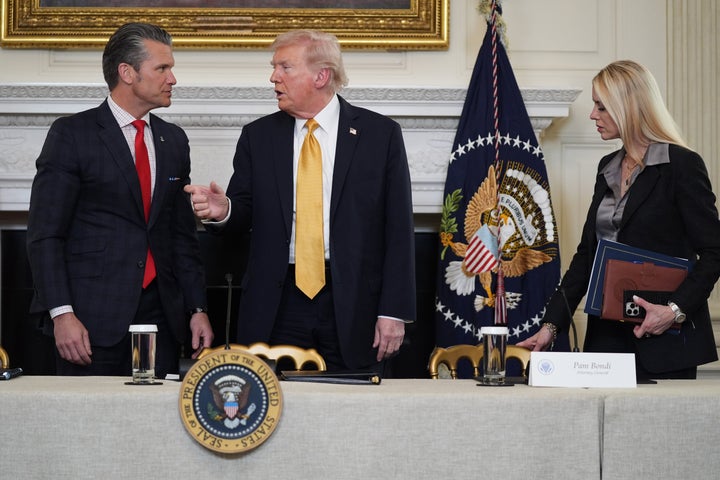
“We tracked them from the beginning. We know who’s behind them, who they are, where they come from, what they have,” Rubio said during an Oct. 22 photo op at the White House.
AP Photo/Evan Vucci
Defense Department officials declined to detail what drugs were recovered or provide any other information about the military attacks, including whether they knew the identities of all the people they had killed. Instead, chief Pentagon spokesman Sean Parnell criticized members of Congress for speaking to reporters.
“The department is deeply concerned that members of Congress are making public statements about information received in a classified briefing. The department considers any unauthorized disclosure of classified information as [a] serious violation of national security,” he said in a statement.
Brian Finucane, who spent a decade in the State Department’s legal office, questions what the real purpose behind the ship assassinations really is.
“If these attacks are not intended to counter fentanyl, what good are they? For the president, they are a dramatic and performative military action,” he said. “For the Secretary of State, they are another pressure tactic in a campaign aimed at regime change in Caracas.”
Harrison Mann, a former Defense Intelligence Agency official and Army officer now working to persuade service members not to follow what he believes are illegal orders to kill noncombatants, also suspects the attacks have more to do with getting rid of Venezuela’s dictator, Nicolás Maduro.
“The administration’s SOUTHCOM campaign revolves around three things, and none of them have to do with the overdose crisis,” Mann said, referring to the military Southern Command responsible for South America and the Caribbean. “One, produce murder cam videos to distract from their abject failure to improve life in the United States. Second, test the extent to which the military will obey what military lawyers call ‘patently illegal’ orders, such as carrying out extrajudicial executions in the Caribbean. And three, pander to neoconservative obsessions with launching Iraqi-style regime change disasters in Venezuela and beyond.”
Trump has used the hundreds of thousands of fentanyl overdose deaths in recent years to justify tariffs against China for allowing production of precursor chemicals, Mexico for being the drug’s final manufacturing site, and Canada even though it plays virtually no role in the fentanyl problem in the United States.
Trump’s attacks on low-level smugglers on ships in the Caribbean and eastern Pacific appear in that sense to resemble his treatment of Canada, based on a false claim about fentanyl. Except instead of facing tariffs, suspected smugglers face violent death from the sky.
Reimagining smugglers as war combatants rather than criminals created the absurd situation in which the US Navy, after attacking a ship with the intention of killing everyone on board in an October 16 attack in the Caribbean, pulled two survivors from the water and returned them to Colombia and Ecuador rather than handing them over to face criminal charges in the US.
Which means that both, by Trump’s logic, were so dangerous that they had to be killed rather than arrested at the time of the missile attack, but so harmless that they could be released to their home countries just days later.
“Let’s not pretend the Trump administration cares about preventing overdose deaths while they are cutting billions from prevention and treatment programs that actually save lives,” Mann said, referring to proposed budget cuts and layoffs that advocates say have dramatically harmed the country’s response to the addiction crisis.
Fentanyl has been particularly dangerous for drug users because it is much cheaper to produce than heroin, which many addicts and recreational users turned to after the crackdown on pharmaceutical-grade opioids like OxyContin began more than a decade ago. It is also much more deadly because overdoses can occur even with trace amounts. In the United States, there are approximately 80,000 overdose deaths per year, although the number has been decreasing since 2022.
“Most of the fentanyl found in the United States is manufactured in Mexico and smuggled across the border by American citizens, and a smaller amount is manufactured within the United States itself,” Mann said. “There is no evidence that Venezuela plays a significant role in the production of synthetic opioids, and even if that were somewhat true, military action, in the most optimistic scenario, would simply shift production elsewhere.”
California Democrat Ro Khanna, a member of the House Armed Services Committee, said whatever Trump’s motive for using military force is, he still has to go to Congress.
“Trump’s attacks off the coast of Venezuela are a stain on our country’s conscience. The Constitution requires the president to go to Congress for approval. We must firmly oppose a war of regime change,” he told News themezone.
HeReactionIt’s here!
Your supportFuelsOur Mission
Your supportFuelsOur Mission
Cut the chaos
Americans just sent Trump a clear message, and Democrats are calling it “a five-alarm fire” for the president. Our reporters are here to keep you informed and make sense of the chaos in Washington. Join News themezone and be a part of what happens next.
We remain committed to bringing you the unwavering, fact-based journalism everyone deserves.
Thank you again for your support along the way. We are truly grateful for readers like you! Your early support helped get us here and strengthened our newsroom, keeping us strong in uncertain times. As we continue, we need your help more than ever. We hope you will join us once again.
We remain committed to bringing you the unwavering, fact-based journalism everyone deserves.
Thank you again for your support along the way. We are truly grateful for readers like you! Your early support helped get us here and strengthened our newsroom, keeping us strong in uncertain times. As we continue, we need your help more than ever. We hope you will join us once again.
News themezone Support
Are you already a member? Sign in to hide these messages.
News themezone’s Igor Bobic contributed to this report.