



White House architect teases another major change this time outside the Oval Office
WASHINGTON (AP) — The White House said Thursday that saving the East Wing was not feasible due to structural problems, past deterioration and other major concerns, as officials shared details of President Donald Trump’s planned ballroom at a public meeting of the committee tasked with approving it.
Josh Fisher, director of the White House Office of Management, said an unstable colonnade, water leaks, mold contamination and other problems made it cheaper to tear down the East Wing to make room for the $400 million ballroom than to renovate it.
“Due to this and other factors, the cost analysis demonstrated that demolition and reconstruction provided the lowest total cost of ownership and the most effective long-term strategy,” Fisher told members of the National Capital Planning Commission.
via News
It was the most complete explanation to date of the dramatic demolition of the east wing, which caused a public uproar when it began in October without warning.
Committee Chairman Will Scharf, who is also a senior White House official, said he thought the bill would eventually be approved.
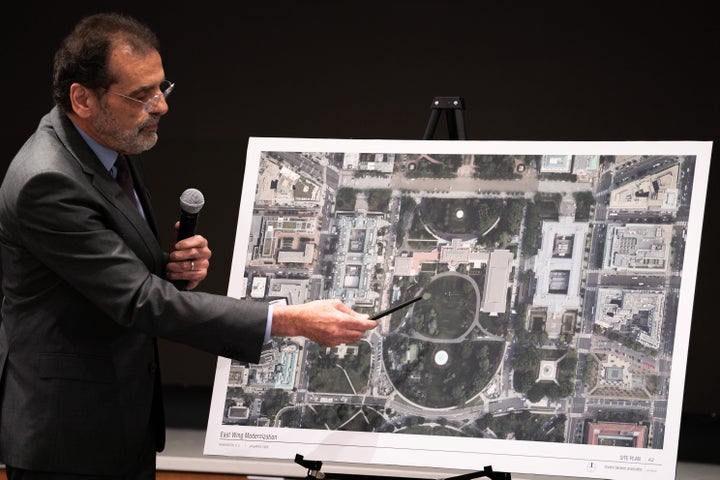
Project architect Shalom Baranes joined Fisher to provide a high-level view of the proposal to the commission. Baranes showed renderings of the ballroom panel and views of the White House complex from the north and south with the addition.
Baranes said the design could include adding a second story to the West Wing colonnade to help make the White House more seamless with the new ballroom on the east side. But such a move would also dramatically alter the iconic space outside the Oval Office.
Fisher and Baranes said the project includes more than just a ballroom, and will also streamline visitor access to the White House and make unspecified improvements to Lafayette Park across the street.
Some of the 12 commissioners expressed concerns, most notably Democrat Phil Mendelson, who asked several questions about the size and location of the ballroom and whether that could change in the future. Baranes stated that “anything is possible,” but added that the plans have been carefully studied.
Mendelson, who is also president of the D.C. Council, asked if the planned ceiling height of 38 to 40 feet (11.5 to 12 meters) could still be reduced before the final structure is completed and received assurances that the number was not completely set. “It still seems to me like it’s overwhelming the existing building,” Mendelson said.
Baranes said the idea would be to build the height of the room to ensure it matches the rest of the White House. “The heights will match exactly,” he said.
Scharf listened to those and other questions Mendelson posed. However, once completed, the ballroom is expected to be larger than the rest of the existing White House.
Mendelson also questioned why the project had not been fully presented to the commission before the east wing was torn down. Fisher said some aspects of the ballroom construction were “top secret in nature” and needed to be addressed.
Scharf repeated his previous assertions that the planning commission typically does not have jurisdiction over site work and demolition on any project, including at the White House.
After the meeting, he expressed confidence that the project will receive the go-ahead.
“Certainly, based on today’s presentation, I fully expect that the commission … will approve this project,” Scharf told reporters. “I think you’ve just seen a very positive response to these preliminary drawings.” He acknowledged Mendelson’s concerns and suggested they be addressed.
Only commissioners were allowed to ask questions and offer comments at the meeting. A more formal review, including public testimony and votes, is expected after the White House presents a more detailed proposal. The panel’s next meeting is February 5.
Before the meeting adjourned, Scharf argued that the White House needed a larger, fancier space for important functions. He recalled visiting Windsor Castle last year with Trump and said that when the president is likely to host Britain’s King Charles III, “he will most likely be greeted in a tent on the South Lawn with port-a-potties.”
Scharf also said after the meeting that the commission is interested in more than whether the ballroom is a good idea. He said his concerns extend to how it affects visitors’ experience of the White House and how the building fits in with others in the area and throughout the city.
Recently Offered Plans
In December, the White House presented its plans for the ballroom to the commission, which is one of two federal panels that review construction on federal lands, usually before construction begins. The National Trust for Historic Preservation sued to stop construction of the ballroom, accusing the Trump administration of violating federal law by proceeding before submitting the project for independent reviews, congressional approval and public comment.
Carol Quillen, president and CEO of the Trust, said in a later statement that the presentation at the White House was a “good and necessary first step.” He urged the administration to comply with all legally required review and approval processes before starting construction.
A summary on the commission’s website said the purpose of the “East Wing Modernization Project” is to “establish a permanent, secure event space within the White House grounds” that provides increased capacity for official state functions, eliminates reliance on temporary tents and support facilities, and “protects the historic integrity and cultural landscape of the White House and its grounds.”
A comprehensive design plan for the White House prepared in 2000 identified the “need to expand event space to address growing visitor demand and provide a suitable venue for major events,” the summary said. He added that successive administrations had “recognized this need as an ongoing priority.”
The size and scope of the ballroom has grown
Trump, a Republican serving his second term, has been talking for years about building a ballroom in the White House. Last July, the White House announced that a 90,000-square-foot (8,400-square-meter) space would be built on the east side of the complex to accommodate 650 seated guests, at a then-estimated cost of $200 million. Trump has said it will be paid for by private donations, including his own.
He later increased the ballroom’s capacity to 999 people and, by October, had demolished the east wing. In December, it updated the price to $400 million, double the original estimate.
The White House had announced few more details about the project but said it would be completed before Trump’s term ends in January 2029.