



World
/News/News
Add News themezone on Google
A red stencil of a hand pressed against an Indonesian cave wall is the oldest rock art ever discovered, scientists said Wednesday, and sheds light on how humans first migrated to Australia.
Rock art dates back at least 67,800 years, according to research published in the journal Nature by a team of Indonesian and Australian archaeologists.
“We have been working in Indonesia for a long time,” study co-author Maxime Aubert of Australia’s Griffith University told News.
This time they ventured into caves on the island of Muna, in the province of Sulawesi, following the advice of Indonesian archaeologist Adhi Agus Oktaviana, lead author of the study.
There they found “negative handprints, stenciled, probably using red ocher,” Aubert said.
The fingers of one of the hands were “retouched to make them pointy like claws, a style of painting only seen in Sulawesi,” the Canadian archaeologist added.
Study co-author Adam Brumm told Reuters that the claw-shaped design “had a deeper cultural meaning, but we don’t know what it was.”
“I suspect it had something to do with the complex symbolic relationship of these ancient people with the animal world,” Brumm told Reuters.
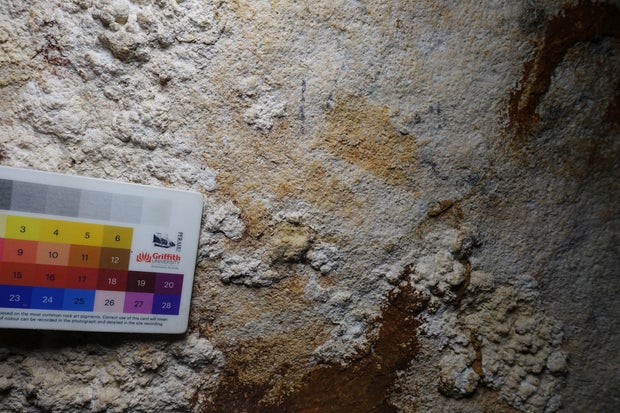
To determine the age of the art, the team took five-millimeter samples of “cave popcorn,” which are small clumps of calcite that form on the walls of limestone caves.
They then hit the rock layers with a laser to measure how the uranium decayed over time, compared to a more stable radioactive element called thorium.
This “very precise” technique gave scientists a clear minimum age for the painting, Aubert explained.
At 67,800 years old, the Indonesian stencil is more than a thousand years older than other hand stencils found in a Spanish cave that have been attributed to Neanderthals. However, the dating of this rock art “has been controversial,” the study warned.
The new discovery is also more than 15,000 years older than previous art found in the Sulawesi region by the same team.
Scientists also discovered that the Muna caves were used many times over a long period for rock art.
Some of the ancient artworks were even painted up to 35,000 times later, Aubert said.
A fork in the road
Beyond setting a new record, the art also offers clues to a long-standing historical mystery.
Scientists have been divided over how Homo sapiens first traveled from Asia to Australia.
They could have taken the northern route, traveling by boat through the Indonesian islands, including Sulawesi, to Papua New Guinea.
These ancient humans could have walked the rest of the way; At the time, Papua New Guinea and Australia were part of a supercontinent called Sahul.
Or the migrants could have taken the southern route, passing through the islands of Sumatra, Java and Bali before heading to Timor. A boat trip was then necessary to finally reach Australia.
“These paintings provide the first evidence that modern humans were on these Indonesian islands at that time,” Aubert said.
The discovery also “reinforces the idea that people came to Australia via Papua, perhaps around 65,000 years ago,” he said.
But it cannot be ruled out that other people were also arriving in Australia via the southern route at the same time, he added.
The researchers also said the paintings were most likely created by people closely linked to the ancestors of indigenous Australians.
In 2018, Aubert led a team of scientists who found the oldest known example of an animal drawing– A red silhouette of a bull-like beast on the wall of another Indonesian cave. Researchers said the sketch was at least 40,000 years old, slightly older than similar ones. animal paintings found in famous caves in France and Spain.
Cave paintings of prehistoric marine life have also been found, dating back more than 30,000 years. found at the bottom of the Mediterranean Sea off the south of France.
The News contributed to this report.
In:
- Archaeologist
- Indonesia